Galleon 2026Download our mobile shopping application for faster and easy transaction.

Product ID:
657901
Identifier:
0312427999
Brand:
Holt Paperbacks
Model:
Shipping Weight:
1.21 lbs
Manufacturer:
Holt Paperbacks
Shipping Dimension:
8.31 x 5.55 x 1.34 inches
₱2,476
₱1,211
+ ₱ 630
Shipping Cost from USA to Philippines inclusive of custom fees.
Cost too high? Check weight and dimension on product details and click "I think this is wrong?" link.
Get it between 2026-06-06 to 2026-06-13.
Additional 3 business days for provincial shipping.
- Price and Stocks may change without prior notice
- Packaging of actual item may differ from photo shown
Cash upon Pick-up - orders grand total must not exceed ₱5,000.00. Order will be pickup at Galleon's Office.
Cash on Delivery - orders grand total must not exceed of ₱10,000.00 and must not exceed ₱5,000.00 for provincial areas. See all payment methods
neo-liberal economics in action
the Chicago School of economics
disaster capitalilsm
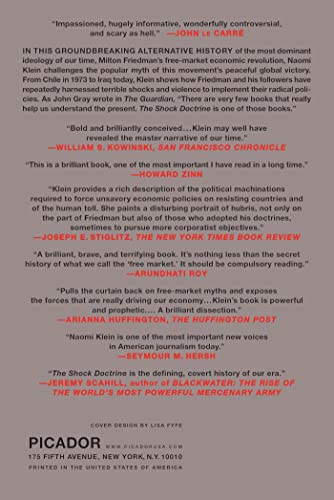
International Bestseller Winner of the Warwick Prize for Writing 18th in The Guardian's top 100 Greatest Books since 2000 "Impassioned, hugely informative, wonderfully controversial, and scary as hell.” ―John le Carré The bestselling author of No Logo shows how the global "free market" has exploited crises and shock for three decades, from Chile to Iraq In her groundbreaking reporting, Naomi Klein introduced the term "disaster capitalism." Whether covering Baghdad after the U.S. occupation, Sri Lanka in the wake of the tsunami, or New Orleans post-Katrina, she witnessed something remarkably similar. People still reeling from catastrophe were being hit again, this time with economic "shock treatment," losing their land and homes to rapid-fire corporate makeovers. The Shock Doctrine retells the story of the most dominant ideology of our time, Milton Friedman's free market economic revolution. In contrast to the popular myth of this movement's peaceful global victory, Klein shows how it has exploited moments of shock and extreme violence in order to implement its economic policies in so many parts of the world from Latin America and Eastern Europe to South Africa, Russia, and Iraq. At the core of disaster capitalism is the use of cataclysmic events to advance radical privatization combined with the privatization of the disaster response itself. Klein argues that by capitalizing on crises, created by nature or war, the disaster capitalism complex now exists as a booming new economy, and is the violent culmination of a radical economic project that has been incubating for fifty years.

Buy products not available in the Philippines.